
C-PACE Recapitalization & Look-Back Financing
Unlock capital already invested in your commercial property

C-PACE can refinance qualifying costs incurred during recent construction, renovation, repositioning or major building improvements. This allows owners to introduce long-term, fixed-rate, non-recourse capital after work is underway or complete, where permitted by the applicable C-PACE program.
The proceeds can support a broader recapitalization by paying down bridge or senior debt, reducing higher-cost capital, replenishing sponsor liquidity or extending the property’s runway to stabilization.
Bayview PACE evaluates C-PACE within the complete capital stack. As a direct balance-sheet lender, Bayview can provide C-PACE independently or evaluate a combined financing solution with Bayview bridge or construction capital.
Long-term, fixed-rate, non-recourse capital. Look-back periods vary by program and may extend three years or more.
What Is C-PACE Look-Back Financing?
Look-back C-PACE is retroactive financing for eligible improvements that have already been completed and paid for.
Within the look-back period permitted by the applicable state or local program, a property owner can refinance qualifying project costs incurred up to three years after completion, and in some jurisdictions longer, with long-term C-PACE capital.
Instead of leaving sponsor capital or short-term debt tied up in those costs, the owner can use the financing as part of a broader recapitalization strategy.
Look-back financing can be applied to recently completed construction, renovations, building-system replacements, repositioning work and other qualifying improvements. Bayview currently advertises a potential look-back period of three years or more, subject to program availability.
Unlike a conventional cash-out refinance, C-PACE sizing begins with documented eligible expenditures. Completion dates, property value, program rules, underwriting and senior lender consent can also affect the amount and structure of the financing.
More Than Reimbursement for Past Costs
Look-back C-PACE begins with qualifying historical expenditures, but its value extends beyond reimbursing individual project costs.
A properly structured recapitalization may help an owner achieve several capital-stack objectives.
Refinance Qualifying Costs
Recover capital previously used to pay for eligible construction, renovation or building-improvement expenses.
Pay Down Bridge or Senior Debt
Use long-term C-PACE capital to reduce a portion of existing short-term or senior financing.
Reduce Higher-Cost Capital
Replace or reduce mezzanine debt, preferred equity, equity partners or other more expensive sources of capital.
Replenish Sponsor Liquidity
Recycle capital into lease-up, another project phase, future developments or other approved business needs.
Extend the Stabilization Runway
Introduce longer-duration capital while a recently completed property continues leasing, opening or reaching stabilized operations.
Combine Past and Future Costs
Where program rules permit, finance eligible historical expenditures alongside ongoing or planned improvements within one transaction.
Bayview transactions have used look-back C-PACE to pay down bridge debt, provide sponsor liquidity, refinance completed renovations, close gaps within broader capital stacks and combine retroactive financing with future eligible work. (Bayview PACE)
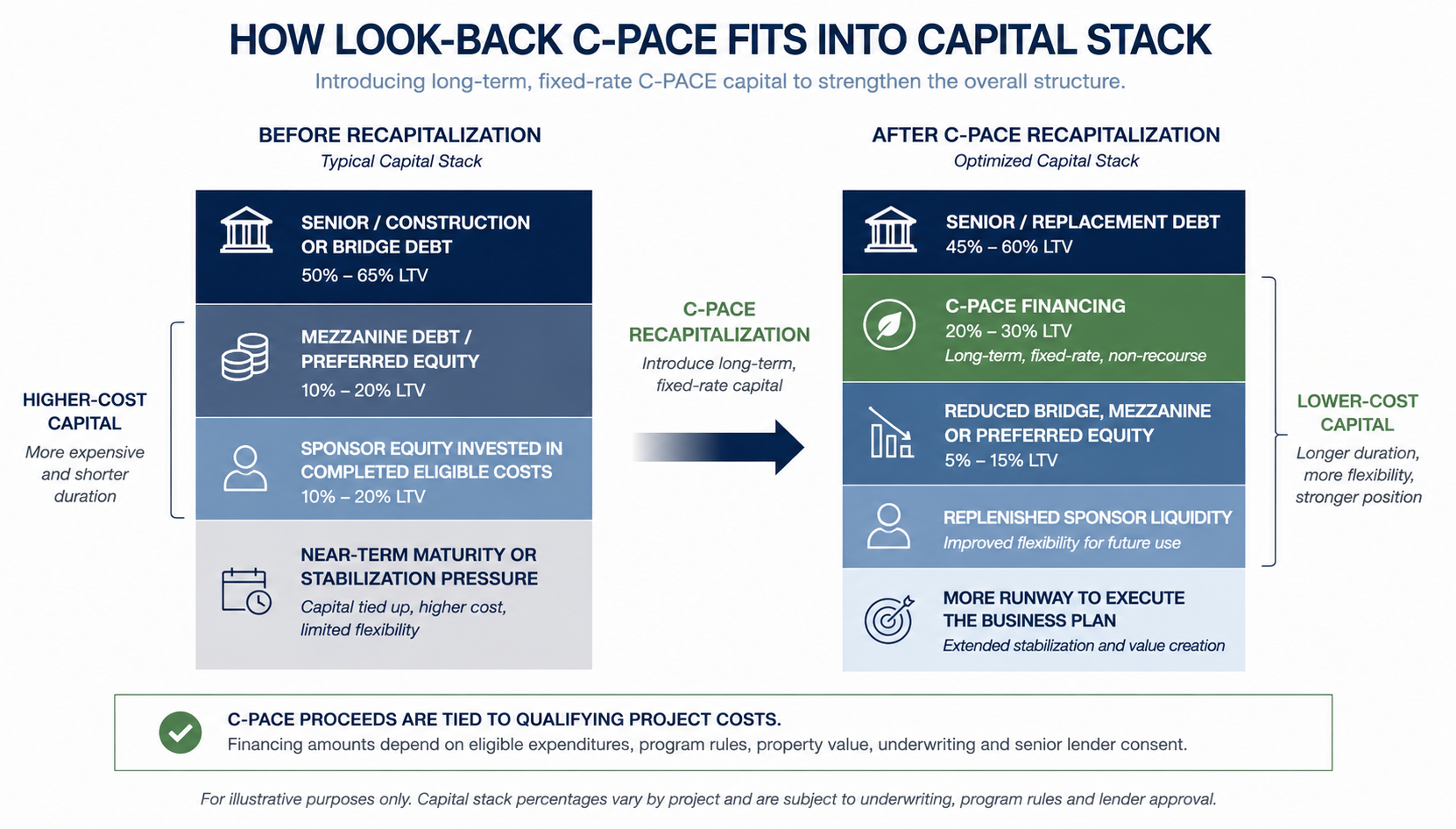
How Look-Back C-PACE Fits Into the Capital Stack
A C-PACE recapitalization can introduce long-term capital into a property that is already complete, near completion or operating.
Before Recapitalization
- Existing construction, bridge or senior debt
- Mezzanine debt or preferred equity
- Sponsor capital invested in completed eligible costs
- Near-term maturity or stabilization pressure
After C-PACE Recapitalization
- Senior or replacement debt
- Long-term C-PACE financing
- Reduced bridge, mezzanine or preferred equity exposure
- Replenished sponsor liquidity
- More runway to execute the property’s business plan
How C-PACE Recapitalization Works
1 – Initial Fit Review
Bayview reviews the property’s location, asset type, project timeline, current capital stack, financing objectives and applicable C-PACE program.
2 – Eligible-Cost Analysis
Bayview evaluates the construction or improvement budget, completion dates, invoices, proof of payment and other documentation needed to identify qualifying historical costs.
3 – Financing Structure
Potential C-PACE proceeds are sized and evaluated alongside existing senior debt, bridge financing, higher-cost capital, property value and the sponsor’s business plan.
4 – Program & Lender Coordination
Bayview coordinates applicable program requirements, required third-party reports and the senior mortgage lender consent process.
5 – Closing & Funding
The C-PACE financing closes and proceeds are applied according to the approved transaction structure, which may include refinancing eligible costs, paying down existing debt or funding additional qualifying work.
Ready to get started with
C-PACE Financing?
Or do you have additional questions? Connect with our team.
Ready to get started with C-PACE Financing?
Connect with our team!