
Mid-Construction & Completion Capital
C-PACE and bridge financing for projects already underway

Construction financing needs can change after a project has started. Costs may increase, timelines may shift, senior loan proceeds may be limited, or a project may require additional capital to reach completion and stabilization.
C-PACE can be introduced during construction to finance qualifying project costs, address a gap in the capital stack and provide long-term, fixed-rate, non-recourse capital.
Bayview PACE can provide standalone C-PACE financing or evaluate a combined solution that includes construction or bridge capital. Our team considers the work completed, remaining budget, existing debt, sponsor objectives and takeout strategy within the context of the entire transaction.
Financing solutions for qualified commercial real estate projects.
When the Original Capital Stack No Longer Matches the Project
A mid-construction capital need does not necessarily mean a project is distressed.
Commercial developments frequently experience changes in costs, timing, scope and financing availability after construction begins. The original capital stack may no longer provide enough proceeds, flexibility or runway to execute the current business plan.
Additional capital may be needed because of:
Cost Overruns & Change Orders
Material, labor, design or scope changes can increase the remaining cost to complete the project.
Limited Construction Loan Proceeds
The existing lender may be unwilling or unable to increase its commitment as the project budget changes.
Delayed Sponsor or Investor Capital
Equity contributions, partner capital or anticipated project proceeds may not arrive on the original timeline.
Interest Reserve & Carry Needs
Construction delays can increase interest, taxes, insurance and other carrying costs before the property begins generating stabilized revenue.
Maturing Construction or Bridge Debt
A loan maturity may occur before construction, lease-up, unit sales or stabilization is complete.
Partially Completed Project Acquisitions
A new sponsor may acquire an unfinished development and need a revised financing structure to complete and reposition the property.
The objective is to identify the current gap, determine which project costs may qualify for C-PACE and structure the remaining capital around a realistic path to completion.
How C-PACE Can Bridge a Mid-Construction Financing Gap
C-PACE can finance a qualifying portion of project costs after construction has already begun, subject to the applicable state or local program.
Depending on the project stage and financing structure, C-PACE proceeds may be used to:
Complete the Capital Stack
Add another source of capital when existing construction debt and sponsor equity are not sufficient to cover the current project budget.
Finance Remaining Construction
Fund qualifying hard and soft costs required to complete the project.
Refinance Eligible Costs Incurred to Date
Reimburse qualifying project costs that have already been paid, where permitted by applicable look-back rules.
Address Cost Overruns
Provide additional capital for eligible costs created by changes in pricing, scheduling, scope or construction conditions.
Reduce Higher-Cost Capital
Replace or reduce mezzanine debt, preferred equity or other more expensive sources of capital.
Preserve Sponsor Liquidity
Limit the amount of additional sponsor equity required to finish the project and preserve capital for lease-up, operations or other project needs.
C-PACE does not need to replace the existing financing. It can complement construction or bridge debt by financing the qualifying portion of the project budget.
How C-PACE and Bridge Financing Can Work Together
C-PACE and bridge financing can address different parts of a project’s capital needs.
C-PACE Financing
C-PACE provides long-term, fixed-rate, non-recourse financing for eligible project costs. It may remain in place through construction, stabilization and the property’s longer-term operating period.
Bridge Financing
Bridge capital can address broader transitional needs, including construction completion, carrying costs, lease-up, repositioning or the period before permanent financing becomes available.
Combined Financing
A combined structure can use C-PACE for qualifying project costs and bridge or construction financing for the remaining capital needs.
This can create a more complete financing solution while reducing dependence on mezzanine debt, preferred equity or additional sponsor capital.
Bayview provides financing solutions that combine C-PACE lending with construction and bridge capital, allowing the components to be evaluated within one broader capital strategy.
One Platform for the Full Capital Stack
Many C-PACE providers focus only on the C-PACE component of the transaction.
Bayview takes a broader view.
As part of an institutional commercial real estate lending platform, Bayview PACE can evaluate C-PACE alongside the project’s existing construction loan, bridge debt, remaining funding requirements and takeout strategy.
Depending on the transaction, Bayview may provide:
- Standalone C-PACE financing
- C-PACE paired with Bayview construction financing
- C-PACE paired with Bayview bridge financing
- A coordinated structure with an outside senior lender
- Financing for both previously incurred and remaining qualifying costs
- Capital structured in stages or tranches to align with construction progress
For developers and property owners, this can provide a more coordinated approach to:
- Cost-to-complete analysis
- Eligible-cost review
- Construction and bridge loan sizing
- C-PACE sizing
- Capital-stack structuring
- Underwriting
- Senior lender consent
- Program coordination
- Draw administration
- Closing and funding
Capital for Every Stage Between Construction and Stabilization
C-PACE and bridge financing can be considered at multiple points after a commercial project has started.
Mid-Construction
The project is actively under construction but requires additional proceeds because of cost increases, scope changes, lender constraints or changes to the original capital stack.
Completion
The development is near completion but needs capital to finish construction, obtain approvals, complete tenant or unit work and prepare the property for operations.
Bridge to Stabilization
Construction is substantially complete, but the property needs additional time for lease-up, unit sales, opening, occupancy or operating performance to reach stabilization.
A project may move through more than one of these stages within the same financing strategy. Bayview evaluates both the immediate completion requirement and the longer-term plan for stabilization, repayment or takeout.
A More Flexible Completion Capital Stack
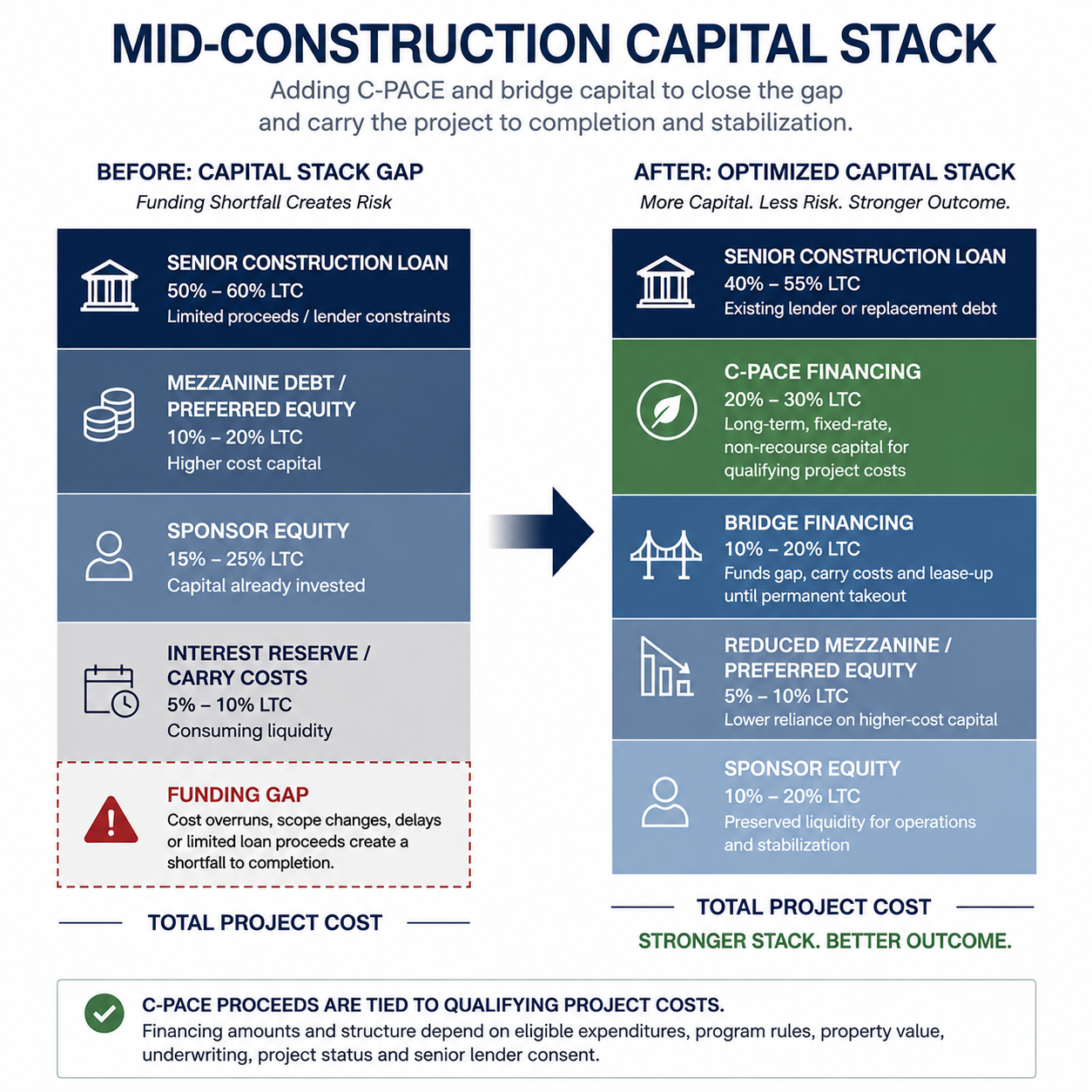
Before introducing C-PACE, a mid-construction capital stack may include:
- Existing senior construction or bridge debt
- Mezzanine debt or preferred equity
- Sponsor equity already invested
- A remaining cost-to-complete gap
- Limited interest reserve or operating runway
After adding C-PACE, the structure may include:
- Senior construction or bridge financing
- Long-term C-PACE financing
- Reduced mezzanine or preferred equity exposure
- A smaller requirement for additional sponsor equity
- Capital aligned with the remaining construction schedule
- Additional runway through completion and stabilization
C-PACE proceeds are tied to qualifying project costs. Financing amounts and structures depend on eligible expenditures, program rules, property value, underwriting, project status and senior lender consent.
The objective is not simply to add leverage. Bayview evaluates whether the revised sources and uses provide a credible path to completion while supporting the property’s broader financing and operating strategy.
What Costs May Qualify Mid-Construction?
C-PACE may finance qualifying completed and remaining costs, depending on the applicable program, project timeline and documentation.
Building Systems & Envelope
- HVAC and mechanical systems
- Electrical, lighting and controls
- Plumbing and water systems
- Elevators
- Roofing, windows and insulation
- Exterior envelope components
Structural & Resiliency Improvements
- Storm protection
- Flood mitigation
- Seismic improvements
- Other qualifying structural or resiliency measures
Related Soft Costs
- Architecture and engineering
- Permitting
- Professional fees
- Other qualifying development costs
Eligibility and financing limits vary by jurisdiction. Bayview evaluates qualifying costs as part of the overall financing analysis.
More Than Rescue Capital
C-PACE has historically been described as “rescue capital” for developments facing delays or cost overruns.
That remains one potential application, but it does not reflect the full role C-PACE now plays in commercial real estate finance.
Mid-construction C-PACE can also be used proactively to:
- Rebalance an otherwise viable capital stack
- Replace higher-cost financing
- Reduce the amount of additional equity required
- Align capital with an updated construction schedule
- Increase the total proceeds available for completion
- Extend the project’s runway to stabilization
- Coordinate construction, bridge and long-term financing
Bayview’s 2026 market research describes C-PACE as an increasingly mainstream capital source and identifies combination financing, where the same platform provides C-PACE and construction capital, as an important evolution in the market. Bayview also reports growing institutional acceptance and regular use of C-PACE in large and complex capital stacks.
The relevant question is no longer simply whether C-PACE can restart a stalled project. It is whether C-PACE, construction financing and bridge capital can be combined to create a more effective path to completion.
Bayview PACE Mid-Construction & Completion Transactions
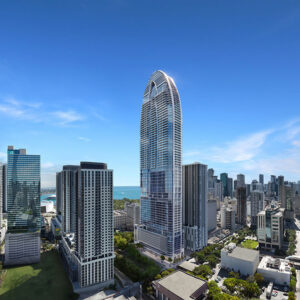
Okan Tower
Miami, FL
Mixed-Use Development
$200,000,000 C-PACE Financing
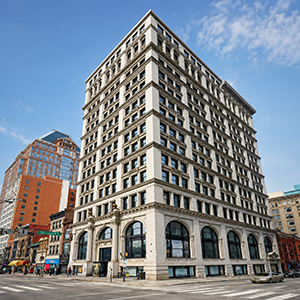
Plaza Baltimore
Baltimore, MD
Multifamily Adaptive Reuse
$15,750,000 C-PACE Financing
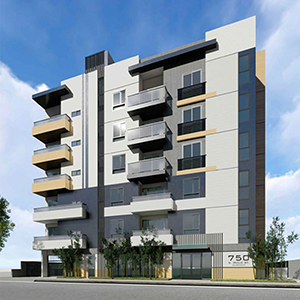
Irolo Condominiums
Los Angeles, CA
Condominium Development
$8,500,000 C-PACE Financing
How Mid-Construction C-PACE Financing Works
1 – Project Status Review
Bayview reviews the project’s location, construction status, work completed, remaining schedule, current debt and financing objectives.
2 – Cost-to-Complete & Eligibility Analysis
The team evaluates the current project budget, remaining costs, historical expenditures, contingencies and documentation supporting qualifying C-PACE costs.
3 – Capital Stack & Bridge Structure
Bayview determines how C-PACE can fit alongside existing construction debt, bridge financing, sponsor equity and other sources of capital.
4 – Program & Lender Coordination
Bayview coordinates applicable program requirements, third-party reports, senior lender consent and the proposed funding structure.
5 – Closing & Construction Funding
The financing closes and funds according to the approved structure, which may include immediate proceeds, construction draws, multiple C-PACE assessments or a coordinated bridge and C-PACE closing.
Need Capital to Reach Completion?
Whether your project is facing a construction gap, approaching a loan maturity, nearing completion or needs bridge capital to reach stabilization, Bayview can evaluate whether C-PACE belongs in the financing structure.
Our team considers the completed work, remaining budget, existing debt and long-term business plan to determine whether standalone C-PACE or a combined construction and bridge solution can move the project forward.
Ready to get started with
C-PACE Financing?
Or do you have additional questions? Connect with our team.
Ready to get started with C-PACE Financing?
Connect with our team!